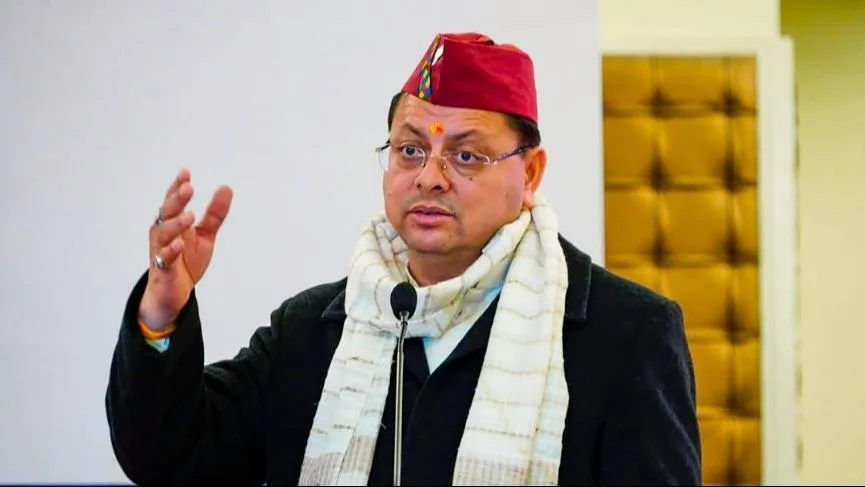
Born on 16 September 1975 in Tundi village of Pithoragarh district, Dhami completed his LLB from Lucknow University and also holds postgraduate qualifications in Human Resource Management and Industrial Relations and a diploma in Public Administration. Before becoming Chief Minister, he represented Khatima in the Uttarakhand Legislative Assembly and later became the MLA from Champawat.
His tenure has been marked by a combination of policy reforms, infrastructure development, investment promotion, tourism, women's empowerment and efforts to strengthen governance.
As of 2026, the Uttarakhand government describes its broader development agenda around good governance, investment, infrastructure, employment and the goal of building a developed Uttarakhand by 2035.
Pushkar Singh Dhami's Political Journey
Pushkar Singh Dhami entered the Uttarakhand Legislative Assembly in 2012 from Khatima. He was subsequently re-elected in 2017 and served as Chief Minister for the first time from 4 July 2021 to 23 March 2022.
Following the 2022 Assembly elections, he began his second term as Chief Minister on 23 March 2022. He later represented Champawat in the Assembly. The Uttarakhand State Disaster Management Authority describes him as the state's 10th Chief Minister and notes that he is the only Chief Minister of Uttarakhand to have assumed a second consecutive term since the state's creation.
His political career has therefore moved from constituency-level politics to state leadership, with his administration increasingly focusing on long-term economic and infrastructure development.
Major Decisions and Achievements Under Pushkar Singh Dhami
One of the most significant policy decisions associated with the Pushkar Singh Dhami government is the implementation of the Uniform Civil Code (UCC).
Uttarakhand implemented its Uniform Civil Code on 27 January 2025, becoming the first state in independent India to bring such a comprehensive uniform civil framework into force. The framework covers areas including marriage, divorce, maintenance and inheritance, and includes provisions relating to registration of live-in relationships.
The UCC has become one of the defining policy issues of Dhami's tenure and has also generated considerable national discussion.
For people searching for "Pushkar Singh Dhami UCC", the implementation of the law is arguably the most important policy associated with his government.
2. Stricter Land Laws in Uttarakhand
Land ownership is a particularly sensitive issue in Uttarakhand because of the state's geography, limited agricultural land and concerns around development in the Himalayan region.
The Dhami government enacted amendments to the state's land law in 2025. According to the Uttarakhand government's official account, the amended law restricts people from outside the state from purchasing agricultural and horticultural land in 11 hill districts.
The stated objective is to prevent misuse of agricultural and horticultural land while protecting the interests of the state's hill regions.
3. Investment and Industrial Development in Uttarakhand Under Pushkar Singh Dhami
Attracting investment has been another major component of the Dhami government's economic strategy.
The Global Investors Summit 2023, held in Dehradun, generated investment proposals exceeding ₹3.5 lakh crore. The Uttarakhand government's 2026 review states that projects representing more than ₹1 lakh crore had already been grounded.
The government's broader strategy is to use Uttarakhand's geographical advantages, natural resources, tourism potential and human capital to attract businesses while encouraging sectors such as manufacturing, food processing, AYUSH and services.
The state's Sashakt Uttarakhand programme aims to double real GDP by 2030 while preserving the state's environmental heritage and creating employment opportunities. Priority sectors include agriculture, tourism, services and manufacturing.
Infrastructure Development Under Pushkar Singh Dhami
Infrastructure has become one of the most visible aspects of Uttarakhand's development agenda.
Rishikesh–Karnaprayag Railway
The Rishikesh–Karnaprayag railway project is being developed to improve connectivity to the state's mountainous regions and important pilgrimage destinations. The state government says work on the railway line is progressing rapidly.
Delhi–Dehradun Expressway
The Delhi–Dehradun Expressway is another major connectivity project with significance for both tourism and business.
According to the Uttarakhand government, the project includes an elevated section and a tunnel near Dat Kali Temple and is expected to significantly reduce travel time between Delhi and Dehradun once operational.
Ropeway Connectivity
Ropeway projects such as Gaurikund–Kedarnath and Govindghat–Hemkund Sahib are also part of the state's broader strategy to improve connectivity to major pilgrimage destinations.
These projects matter beyond tourism because better connectivity can influence employment, logistics, emergency response and economic activity in remote areas.
Tourism: Beyond the Traditional Char Dham Model
Tourism remains one of Uttarakhand's biggest economic opportunities.
The Dhami government has attempted to expand tourism beyond the traditional peak pilgrimage season by promoting winter tourism, religious circuits and new tourism products.
One example is the Manaskhand Mandir Mala Mission, which aims to connect 48 temples in the Kumaon region through a wider tourism and pilgrimage circuit.
The government's Sashakt Uttarakhand strategy also identifies tourism as one of the key sectors for economic growth, with an emphasis on higher-value tourism and new tourism circuits.
For Uttarakhand, this diversification is important because excessive dependence on a few destinations can create congestion, seasonal employment and pressure on local infrastructure.
Women's Empowerment and Employment
Women's participation in the economy is another major component of the state's development agenda.
The Uttarakhand government has implemented 30% horizontal reservation for women of Uttarakhand in government jobs through legislation.
The government has also promoted initiatives such as Lakhpati Didi, self-help groups, the Chief Minister Mahalakshmi Scheme and other programmes aimed at improving women's economic participation.
In July 2026, the Chief Minister stated that more than 2.65 lakh women in Uttarakhand had become self-reliant under the Lakhpati Didi initiative.
For a state where migration from rural and hill regions has long been an economic concern, strengthening local livelihood opportunities for women can have an impact beyond individual households.
Youth, Startups and Self-Employment
Uttarakhand faces a unique challenge: creating employment in a mountainous state where large-scale conventional industries cannot be established everywhere.
The Dhami government's response has included an emphasis on startups, self-employment, homestays, One District-One Product and solar-based entrepreneurship.
The government has specifically highlighted its Startup Policy, One District-One Product programme, Homestay Scheme and Solar Self-Employment Scheme as tools for creating employment and self-employment opportunities for young people.
This approach is particularly relevant for smaller towns and rural areas, where entrepreneurship and tourism-linked businesses can potentially create livelihoods without requiring migration to major cities.
Governance and Digital Public Services
Good governance has been another stated priority of the Dhami administration.
The Uttarakhand government has introduced the Chief Minister Helpline 1905, Corruption-Free App 1064 and the Apuni Sarkar digital platform.
According to the state's official development review, hundreds of government services are available online through Apuni Sarkar, while land records have also been digitised.
The idea is straightforward: citizens should be able to access government services without repeatedly travelling to government offices.
In a geographically challenging state such as Uttarakhand, digital delivery can be particularly valuable for people living in remote areas.
Pushkar Singh Dhami and Uttarakhand's 2035 Vision
In July 2026, Chief Minister Pushkar Singh Dhami reiterated the government's ambition to build a developed and leading Uttarakhand by 2035.
The agenda includes infrastructure, education, healthcare, drinking water, roads, agriculture, tourism, industry, investment, self-employment and development of border areas.
The bigger challenge, however, is not simply announcing development targets.
Uttarakhand has to balance economic growth with environmental sustainability.
The state is vulnerable to landslides, floods and other Himalayan hazards. At the same time, its tourism economy puts significant pressure on roads, water resources, waste management and local ecosystems.
Therefore, the real test of Uttarakhand's development model will be whether the state can create more jobs and infrastructure while protecting its mountains, forests, rivers and local communities.
What Makes Pushkar Singh Dhami's Leadership Significant?
Pushkar Singh Dhami's tenure stands out because several major policy areas have converged during his time in office.
These include:
Implementation of the Uniform Civil Code
Changes to land laws
Investment promotion
Large infrastructure projects
Tourism diversification
Women's reservation and economic empowerment
Startup and self-employment initiatives
Digital governance
Connectivity to remote and border areas
A long-term development vision for 2035
The combination of policy reform and infrastructure-led development has become a defining feature of his administration.
At the same time, evaluating any government requires looking beyond announcements and examining implementation, employment creation, environmental impact, investment actually realised, and improvements in the daily lives of citizens.
Pushkar Singh Dhami's leadership has become closely associated with a new phase of policy reform and development in Uttarakhand.
From the implementation of the Uniform Civil Code and changes to land laws to investment promotion, infrastructure, tourism, digital governance and women's economic empowerment, his government has pursued a broad development agenda.
The next stage may be even more important. Uttarakhand's challenge is to translate large infrastructure investments and policy reforms into sustainable economic growth, quality employment, stronger rural economies and better public services, while preserving the fragile Himalayan environment.
If the state can achieve that balance, the vision of a developed Uttarakhand by 2035 could become more than a government target—it could become a meaningful long-term development model for Himalayan states.
About the Sources
This article uses information from official Uttarakhand government sources, including the Office of the Chief Minister, Uttarakhand State Disaster Management Authority, Uttarakhand Information Department and the official Uniform Civil Code portal. For current policy details, readers should refer to the latest government notifications and orders.